


Key takeaways
- Online banks typically offer higher annual percentage yields on savings products and charge fewer fees than their brick-and-mortar counterparts.
- If you need to deposit cash regularly, you’ll likely want the convenience of a brick-and-mortar bank’s ATM network as many online banks don’t accept cash deposits.
- Large brick-and-mortar banks tend to invest in their technology, so you can also bank online with them.
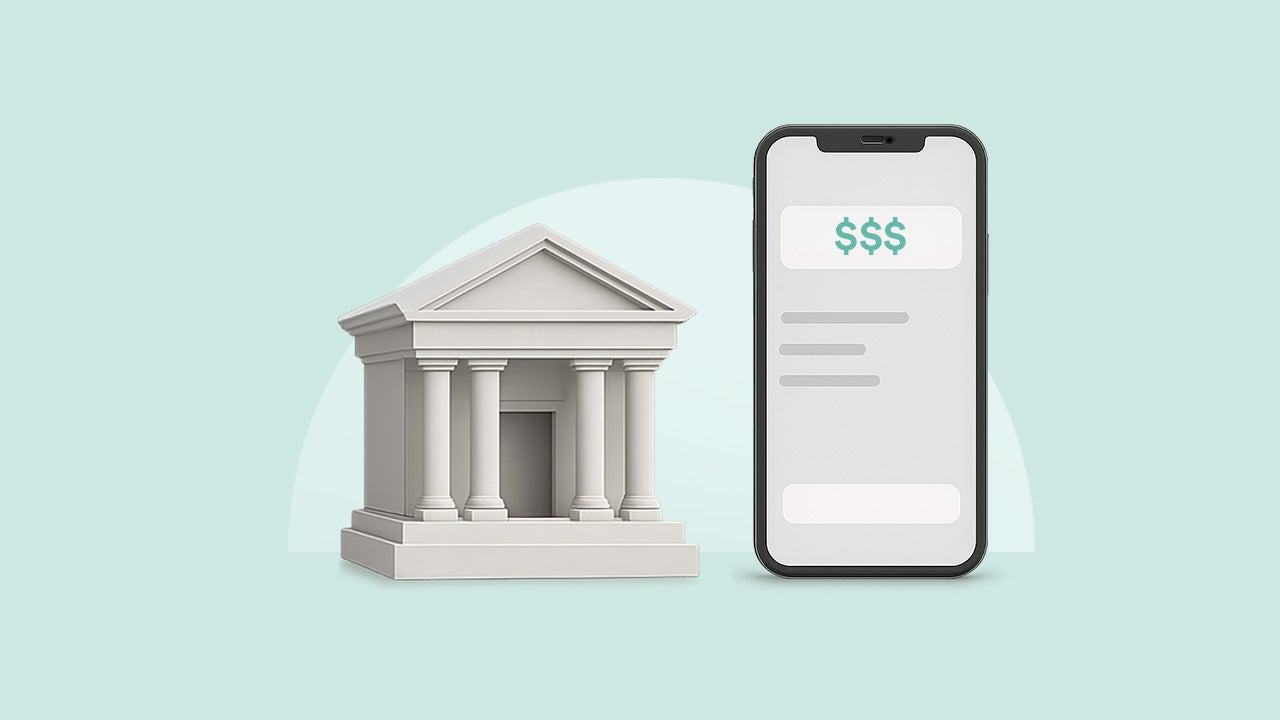
When you’re choosing among the 3,800-plus banks in the U.S., you must decide whether you want a bank that operates solely online, or one with physical branch locations. Brick-and-mortar banks often offer more services and make depositing cash easy, while online banks offer temptingly high annual percentage yields (APYs).
As you compare where to open your next checking or high-yield savings account, learn about the pros and cons of brick-and-mortar banks vs. online-only institutions.
Main differences between brick-and-mortar and online banks
The main difference between brick-and-mortar banks and online banks is the fact that the former has physical branches, while most online banks operate solely online without any locations you can visit for in-person service. But those aren’t the only differences:
| Brick-and-mortar banks | Online banks |
| Physical locations |
Typically no branch locations |
| In-person support available | Support is limited to phone or chat |
|
Tend to offer low APYs on savings and other deposit products |
Usually offer higher APYs on savings and other deposit products |
| Easier to make cash deposits | Cash deposits may be unavailable or come with a fee |
| Out-of-network ATM fees are more likely to be charged |
ATM fees may be reimbursed |
The pros and cons of brick-and-mortar banks
Pros
- Large ATM network.
- Easy to deposit and withdraw cash.
- Wide variety of products and services, including commercial banking.
- Advanced technology for online and mobile banking.
- In-person service.

Cons
- Higher fees.
- Low yields on savings.
Pros of brick-and-mortar banks
Cash accessibility
Depositing and withdrawing cash is easy to do at a physical bank. You can find a branch and have a bank teller’s help, or go to a bank ATM.
Digital tools
Though it may seem like online banks would automatically have the edge in digital tools for their customers, that’s not necessarily the case. Many traditional banks, especially the bigger ones, also offer top-notch online and mobile banking with sophisticated websites, highly-rated mobile apps and other digital tools. That’s because they have the resources to invest in technology and the motivation, since they are competing with online banks and their digital platforms.
Account variety
Besides checking accounts, savings accounts, money market accounts and certificates of deposit (CDs), traditional banks offer mortgages, mortgage refinancing, auto loans, credit cards and other products. If you’re looking to keep a lot of your financial life in one place, a brick-and-mortar bank might be right for you.
In-person service
Traditional banking offers in-person service and sometimes, a personal touch. Customers can stop by their bank and talk to someone who can access their accounts and answer questions. To many people, this is more reassuring than dealing with a person on the phone.
It’s also great if you have a complex problem to solve. However, in-branch support is only helpful if there’s a branch near you and if the business hours work with your schedule.
Cons of brick-and-mortar banks
High fees
Fees are one of the biggest drawbacks of brick-and-mortar banks, which have more overhead than online-only institutions (since they have to pay to run physical locations). Brick-and-mortar banks often charge monthly maintenance fees for their deposit accounts (though they also usually offer ways to waive the fees, too).
Low rates
Traditional banks also typically pay lower rates on deposits. The national average rate on a savings account is 0.62 percent but some of the largest brick-and-mortar banks have savings rates that are even lower — 0.01 percent at Chase Bank, for example.
Despite recent rate drops, many online banks are still paying yields on savings accounts between 3 and 4 percent. Likewise with CDs. The average rate on a one-year CD is 1.9 percent, but online banks dominate our list of the top one-year CD rates by offering around 4 percent.
The pros and cons of online-only banks

Pros
- High rates on deposits.
- No (or low) fees.
- Possible ATM fee reimbursements.
- Sophisticated online experience.
Cons
- Fewer customer service options.
- Potential lack of cash accessibility.
- Fewer account types, products and services.
Pros of online banks
High rates
Why do online banks offer better rates? They’re saving costs in other areas without branches to maintain or as many employees, and they can pass those savings on. Many of Bankrate’s picks for the best high-yield savings accounts are from online banks.
Let’s say you have $10,000 saved and plan not to touch it for a year. If the bank paid 0.01 percent APY, as many big brick-and-mortar banks do, you would earn $1.00 in interest at the end of the year.
Meanwhile, if you put that money into a high-yield savings account at an online bank paying 3.5 percent, you would earn $350 in interest.
Low (or no) fees
Another way online banks attract customers and pass on their savings from not running physical locations is through low (or no) fees. It’s typical for online banks to not charge monthly maintenance fees for checking or savings accounts, unlike their brick-and-mortar counterparts.
Sophisticated online experience
Online-only banks do their business online, so they have an incentive to give their customers a good, clean experience.
Cons of online banks
Cash accessibility is worse (or nonexistent)
Some online banks don’t offer cash withdrawals or deposits, especially if they only have a savings account and CDs in their product suite.
If an online bank does offer cash deposits and withdrawals, it’ll likely be through a partnership with a third-party ATM network such as Allpoint or MoneyPass, or with businesses where you can deal with your cash. For example, Capital One allows cash deposits at stores like Walgreens and CVS, but the process involves getting a barcode and using the mobile app. Similarly, Ally customers can deposit cash at Walmart. Other online banks that offer cash deposits might charge a fee for the privilege.
If your online bank offers an ATM card, you may be able to withdraw cash for free as some online banks offer generous ATM fee reimbursements.
Still, if you deal with cash a lot, an online bank might not be ideal.
No in-person service
Online banks rarely have physical branches, though a few, such as Forbright Bank, have a handful of branch locations within a small geographic region. Capital One is an exception, with about 260 branches.
However, most online banks provide customer service by phone or electronically via FAQs on the bank website, emails or chatbots. If you want more personal assistance, not being able to see a human when you have a problem to solve might be frustrating for you.
Fewer account types
While it’s not unheard of for an online bank to offer a wide-ranging suite of services and products, most offer just a few types of deposit accounts. This might not be a drawback for you if you want to only open a high-yield savings account or CD, but if you want to do all of your banking in one place and also access services like mortgages and loans, you might have more options with a brick-and-mortar bank.
Your money is safe with both brick-and-mortar and online banks
If you’re worried about the safety of conducting your financial business online, or you’re concerned that you may have bigger risks of having your identity stolen with an online bank, you can rest easy. Most banks, online and traditional, use strong encryption, multi-factor authentication and require strong passwords to protect customers’ personal information.
Should you choose a brick-and-mortar bank or an online bank?
Choose the bank that works best for what you need. With an online bank, you’ll likely find a higher APY for your savings. If your financial situation requires more personal customer service or if you handle cash often, however, you’re likely better off with a brick-and-mortar bank. This is also true if you want access to more extensive products and services, like loans, credit cards, or small business, commercial and investment solutions.
Editor’s tip: Have the best of both worlds
You can have multiple accounts at both types of banks for maximum benefits – that’s what I do. Keep your savings in an online bank to get high rates and a checking account at a brick-and-mortar bank to maintain access to in-person banking. Just make sure you can waive the monthly fee, if there is one. Then, link the accounts for easy transfers.
Bottom line
For some, there may be a clear better option between online and brick-and-mortar banks, but you don’t necessarily have to choose one over the other. It could be worth it to keep one account with a local, traditional bank to take advantage of branch services and ATM networks while keeping a high-yield savings account or CD at an online bank to get better rates. In either case, it’s important to compare options between several banks to find the best rates, lowest fees and other features that work for you.
Frequently asked questions
Why we ask for feedback
Your feedback helps us improve our content and services. It takes less than a minute to
complete.
Your responses are anonymous and will only be used for improving our website.
Help us improve our content
Read the full article here